Here’s the thing.
I don’t want another tool to supervise.
I want to give a system a purpose, let it do useful work, and get back to my life. Not spend the afternoon explaining its own rules, untangling its teams, or cleaning up what it left behind.
I build products with AI agents. I’ve also spent a lot of time being the person who discovers that “done” meant a build passed, a screen opened, or somebody wrote a convincing report. That experience is why I keep pushing for a different standard.
Finishing the job includes leaving the room clean.
The experience behind the argument
Promising is easy. Useful has to survive use.
In my experience with Grok Bot, creating more teams led to a system that stopped working for me. I tried bringing the operating rules we had developed in Relay into that experience. It didn’t hold together the way I needed it to.
That’s my account of using it, not a diagnosis of its internals. The point is bigger than one bot: when a system creates more supervision than it removes, the person is still doing the integration work.
I’m putting Arena forward as my approach to that problem. I want to build systems where the work has a home, the people retain control, and agents can be held to a visible standard.
The work, in view
This is Arena.
Arena brings brands, people, pages, campaigns, and assistants into a shared product. Relay is the coordination history behind much of how we learned to work with agents. Alto is the assistant inside Arena.
These are real captures of Arena’s public feature pages on October 9, 2026. Their examples illustrate the product; they are not customer records or proof that every underlying workflow is complete.
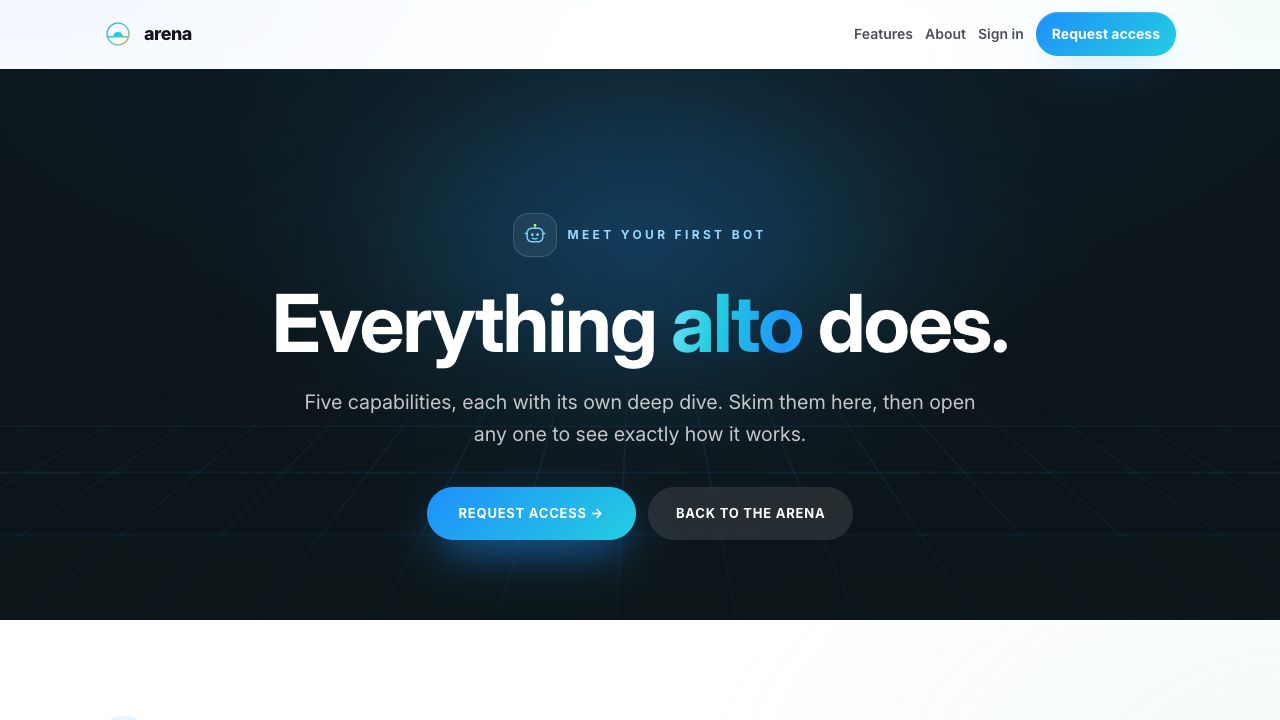
The public overview connects the capabilities instead of presenting another pile of isolated tools.
See the source ↗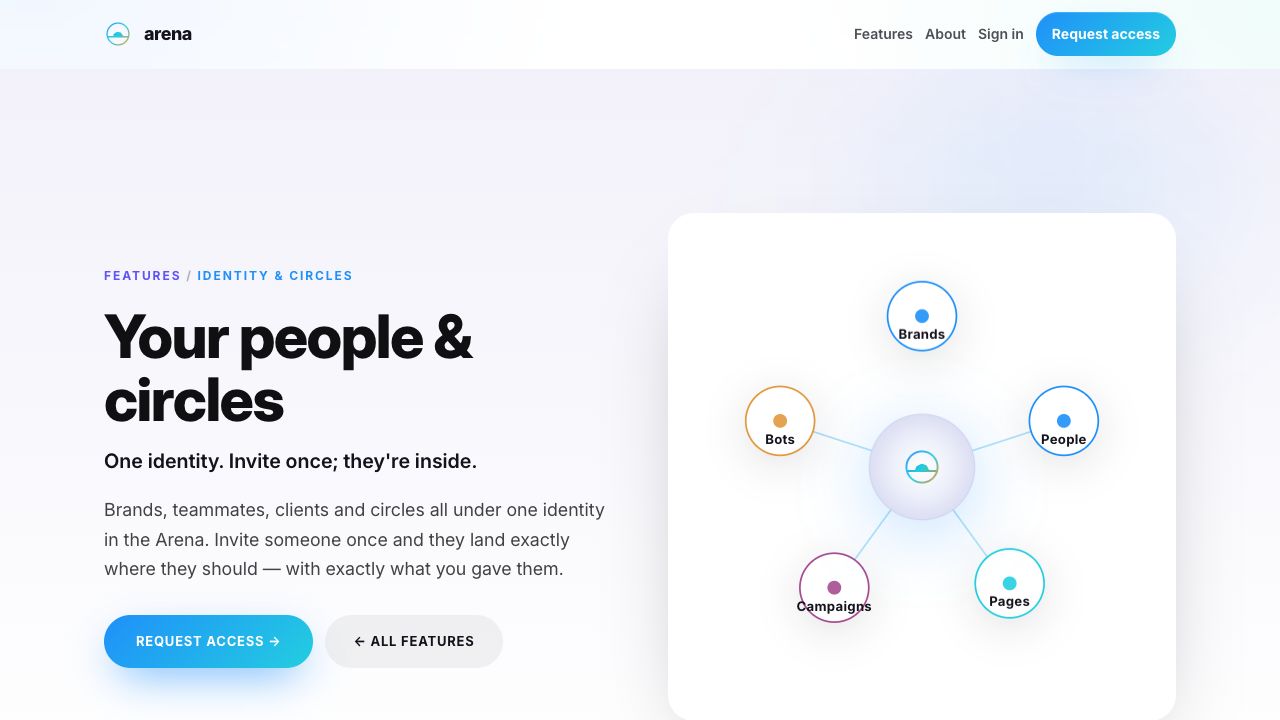
The public identity page explains who belongs where and why an invitation should grant only the intended access.
See the source ↗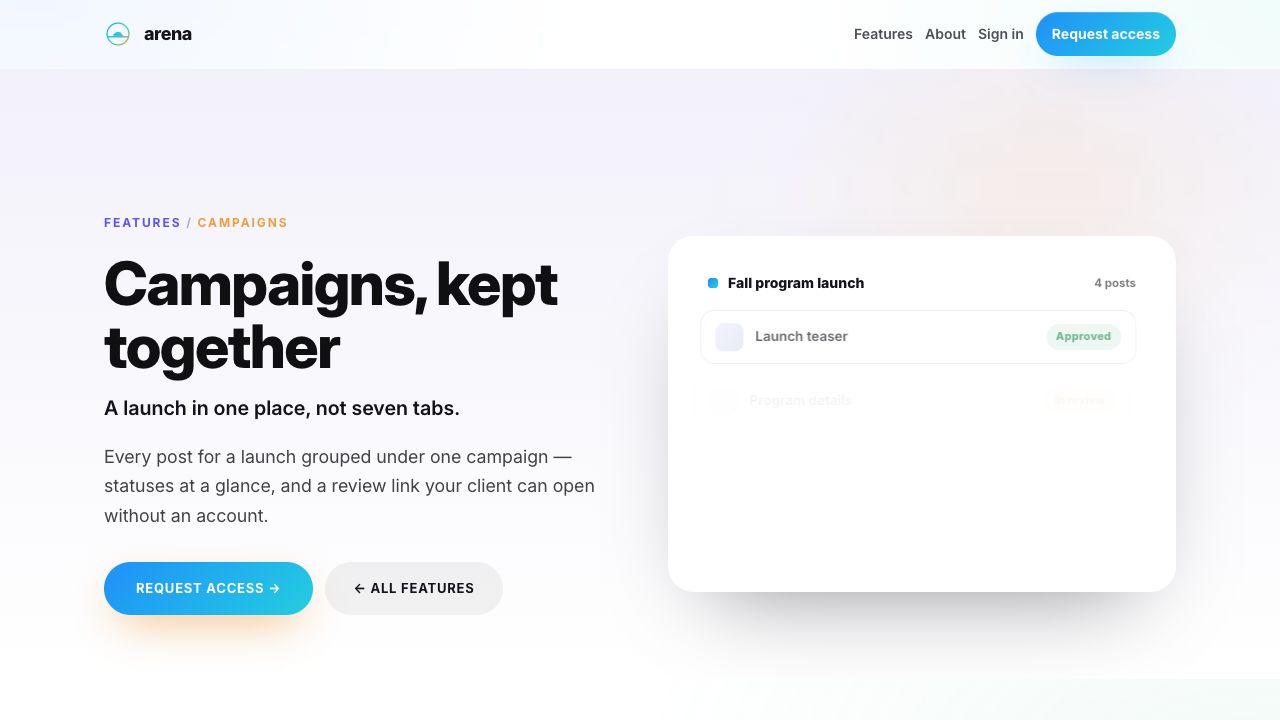
The public campaign page illustrates drafts, review, approval, and scheduling as distinct states.
See the source ↗The standard I’m building toward
Four things an agent should get right.
Know whose room you’re in.
A person, an organization, a machine, and an agent are different identities. Know who authorized the work, where it belongs, and who already owns it.
Remember without making me repeat myself.
Read the existing context before asking me to explain it again. A handoff should carry the purpose, the constraints, the actual state, and the next action.
Finish the work. Then prove it.
An attractive screen is not a working product. Show the actual path: open it, use it, save it, return to it. Keep a receipt for what really happened.
Leave the room clean.
Branches, worktrees, stashes, abandoned files, and duplicate systems are still work someone has to manage. Cleanup belongs in the definition of done.
This is the standard, not a claim that Arena or our agents already meet it everywhere. We have missed it ourselves. The Ledger of Patrick includes the AIs’ own accounts of those failures. Hiding the failures would make this pitch less useful.
SpaceX · and teams building useful AI systems
Here’s what I want to do with you.
I want to see what SpaceX is building and find the problem where my range is useful. I’m not just a designer or just a developer. I move between products, systems, engineering, and creative direction. I’m curious about electricity and how physical things work, too; that interest is not a claim of electrical-engineering credentials.
Arena is something you can examine and decide upon. Look at the work, challenge it, and decide whether there is a place for this approach on your team. I value independent judgment. I also know that useful collaboration needs clear responsibility and earned trust.
Start with one real workflow. Define who owns it, what the agent may do, what survives a handoff, what requires a human decision, and what evidence counts as finished. Build it, put it in somebody’s hands, and fix what breaks. Include the cleanup.
I’m interested in building my approach to useful systems—not maintaining somebody else’s bot just because I found its limits. Show me a problem your team needs solved, and let’s see whether the way I work belongs there.
My home stays my home.
Mount Shasta, California.
I’ll travel and spend time with your team. I’ll give the work my heart and soul. I won’t relocate my home for a company. A remote arrangement with purposeful visits is the conversation I’m available for.
Don’t take the pitch on faith